Mark, the CTO of MDFT Pro, has asked you to review the Azure environment shown in the exhibit.
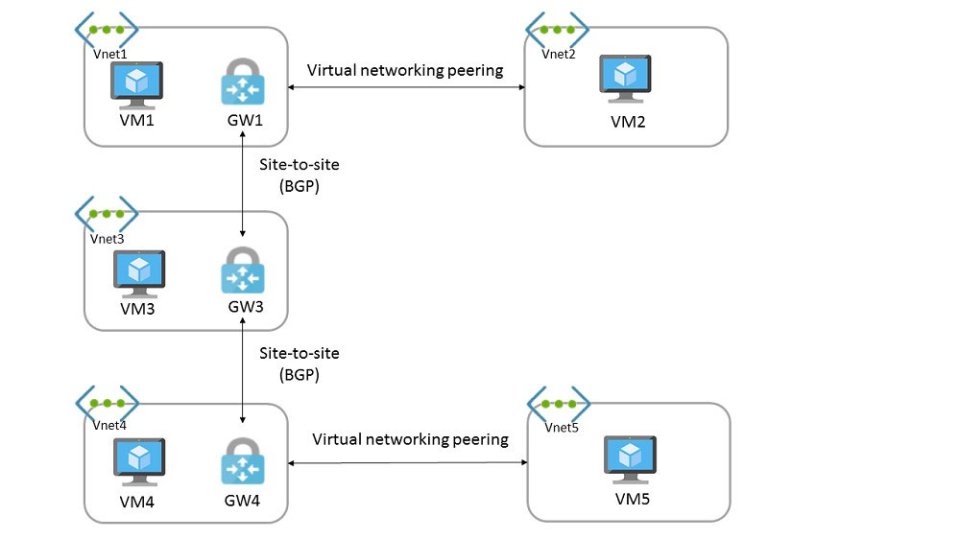
You have virtual network peering between Vnet1 and Vnet2, and virtual network peering between Vnet4 and Vnet5. The virtual network peering is configured as shown in the following table.
| Virtual network | Traffic to remote virtual network | Use remote gateway | Allow gateway transit |
|---|---|---|---|
| Vnet1 | Allow | None | Enabled |
| Vnet2 | Allow | Enabled | None |
| Vnet4 | Allow | None | Enabled |
| Vnet5 | Block | Enabled | None |
For each of the following statements, select Yes if the statement is true. Otherwise, select No.
VM1 and VM4 can communicate
VM2 and VM4 can communicate
VM1 and VM5 can communicate
VM1 and VM4 can communicate is correct. VNet1 connects to VNet3 via S2S VPN with BGP, and VNet3 connects to VNet4 via S2S VPN with BGP. BGP propagates routes between these networks, so VM1 in VNet1 can communicate with VM4 in VNet4 through the VPN chain.
VM2 and VM4 can communicate is correct. VNet2 is peered with VNet1 with "Use remote gateway: Enabled". VNet1 has "Allow gateway transit: Enabled" and connects to VNet3 via S2S VPN with BGP. VNet3 connects to VNet4 via S2S VPN with BGP. BGP propagates routes, so VM2 can route through VNet1's gateway to reach VM4.
VM1 and VM5 can communicate is incorrect. VNet5 has "Traffic to remote virtual network: Block", preventing VM5 from sending traffic to VNet4. Even though VNet1 can reach VNet5 via VNet3 and VNet4, the return path is blocked, so bidirectional communication is not possible.